From Invisible to Booked: How Attractions & Tour Operators Reach Chinese Visitors

Museums, theme parks, day-tour operators, and nature attractions are often overlooked by Chinese tourists — not because they are unappealing, but because they are invisible on the platforms Chinese travelers use to plan their days.
The Attractions Opportunity
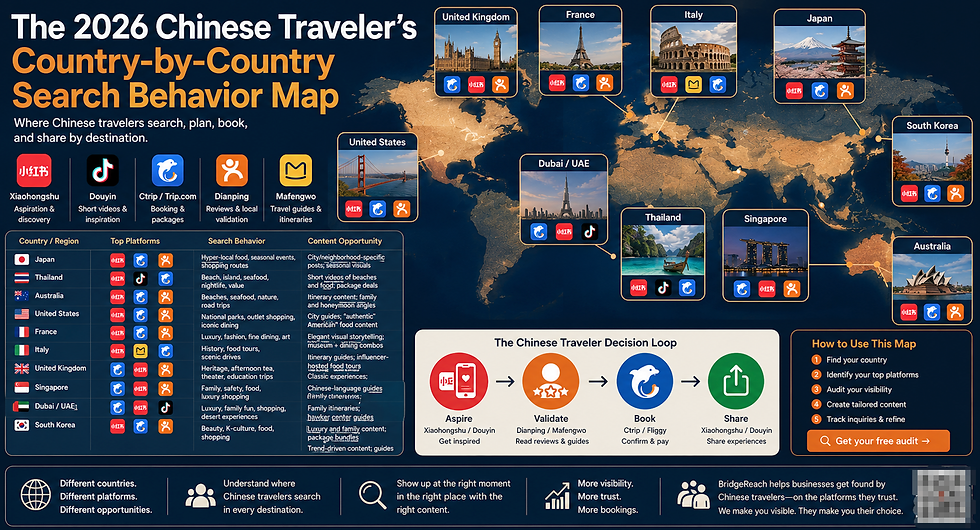
Chinese travelers increasingly build itineraries around experiences, not just shopping and dining. Cooking classes, winery tours, wildlife parks, historical walking tours, and theme parks all have strong demand — if they can be found. The problem is that most attractions outside China rely on Google, TripAdvisor, and Instagram, while Chinese travelers plan on Ctrip, Mafengwo, Xiaohongshu, and Dianping.
How Chinese Tourists Discover Attractions
Platform | Discovery Style | Best Content |
Ctrip / Trip.com | Search and package booking | Detailed listings with photos, reviews, and instant booking |
Mafengwo | Long-form travel guides | "Best day trips from [city]" guides, itineraries |
Xiaohongshu | Visual discovery and "must-visit" lists | Photo carousels, short videos, "hidden gem" angles |
Dianping | Local activity and dining combos | Ticketed experiences bundled with restaurants |
What Makes an Attraction Chinese-Tourist-Ready
Chinese-language booking path. Even a single simplified-Chinese booking page helps.
Clear cancellation and refund policy. Chinese travelers are sensitive to flexibility.
Photo-friendly moments. "Instagrammable" spots perform even better on Xiaohongshu.
Group-friendly options. Family and friend groups are common; private tours and group discounts help.
Mandarin audio guide or signage. A small investment with high perceived value.
Key Takeaways
Attractions are increasingly central to Chinese travel itineraries.
Visibility on Ctrip, Mafengwo, and Xiaohongshu is essential.
Chinese-language booking, flexibility, and photo-worthy moments drive conversions.
Related: How Travel Agencies Can Tap China's Outbound Boom and Ctrip / Trip.com.


Comments