The $170 Billion Question: Who Are Chinese Outbound Travelers?

Excerpt: To market effectively to Chinese travelers, you need to understand who they are — not as a monolithic "market" but as distinct segments with different behaviors, preferences, and spending patterns. This deep dive breaks down the demographics, psychographics, and decision-making process of Chinese outbound travelers in 2026.

The Big Picture
Chinese outbound travel has undergone a fundamental transformation since 2023. The post-pandemic traveler is not the same as the pre-pandemic traveler. Here's what changed:
Dimension | Pre-2020 Traveler | 2025-2026 Traveler |
Trip style | 50%+ group tours | 70%+ independent/free |
Planning horizon | 2-4 weeks | 1-3 months (more research) |
Information source | Travel agent recommendations | Social media (XHS, Douyin, RED) |
Spending pattern | Shopping-heavy | Experience-heavy (dining, activities) |
Destination mix | Top 10 countries only | Expanding to 80+ countries |
Demographic Breakdown
By Age
Gen Z (18-27): ~30% of outbound travelers
Heavy Douyin (TikTok China) and Xiaohongshu users
Value "instagrammable" experiences and unique finds
Lower individual spend but higher social sharing volume
Key phrase: "小众" (niche/undiscovered) — they want to find places their friends haven't
Millennials (28-42): ~45% of outbound travelers
The core demographic for family travel and couples' trips
Highest average spend per trip (~$3,500-5,000)
Research extensively on multiple platforms before deciding
Value authenticity, quality, and "story-worthy" experiences
Most likely to write detailed reviews after their trip
Gen X+ (43+): ~25% of outbound travelers
Often traveling with children or parents
Prefer convenience and reliability over novelty
Higher willingness to pay for premium experiences
Use Ctrip more than social media for planning
By Geography (Where They Come From)
Not all Chinese travelers are the same — origin city dramatically affects behavior:
Origin Tier | Cities | Behavioral Traits |
Tier 1 (一线) | Beijing, Shanghai, Guangzhou, Shenzhen | Sophisticated, experienced, seek authentic/exclusive experiences. High spenders. |
Tier 2 (二线) | Chengdu, Hangzhou, Wuhan, Nanjing, etc. | Growing segment, value-conscious but willing to splurge on "must-do" experiences. |
Tier 3+ (三线及以下) | All others | Newer to international travel, rely heavily on group packages and KOL recommendations. |
Insight for your marketing: Tier 1 travelers from Shanghai/Shenzhen visiting Australia are likely to seek out "hidden gem" cafés in Bondi or Fitzroy. Tier 2 travelers in Gold Coast probably want the "iconic" experience — the restaurant everyone on Xiaohongshu is posting about.
How They Decide Where to Eat
Understanding the decision-making journey is critical. Research from the China Tourism Academy (2025) shows the typical path:
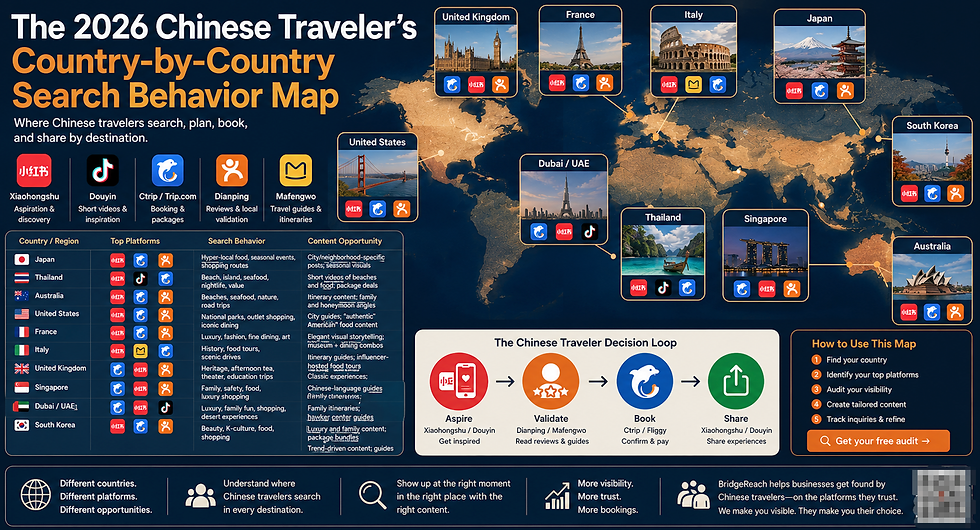
Destination selection (Ctrip, official tourism sites, Xiaohongshu inspiration) — "Where should we go?"
Itinerary planning (Xiaohongshu, Douyin, travel blogs) — "What should we do there?"
Restaurant/venue selection (Dianping, Xiaohongshu, maps) — "Where should we eat?" ← THIS IS WHERE YOU WIN OR LOSE
Real-time decisions (Dianping nearby search, map apps) — "We're hungry, what's close?"
Post-trip sharing (Xiaohongshu, Douyin, WeChat Moments) — "Look where I went!"
Steps 3 and 5 are where your Chinese-platform presence directly impacts revenue.
Spending Patterns: What They Actually Spend Money On
Contrary to the stereotype of Chinese travelers as pure shoppers, 2025-2026 data shows a significant shift toward experience spending:
Category | % of Total Trip Spend (2025) | % of Total Trip Spend (2019) | Change |
Dining & F&B | 28% | 18% | 📈 +10pp |
Accommodation | 24% | 22% | 📈 +2pp |
Activities/attractions | 18% | 12% | 📈 +6pp |
Shopping | 20% | 38% | 📉 -18pp |
Transportation | 10% | 10% | — |
Dining is now the #1 expenditure category for Chinese outbound travelers. This is extraordinary news for restaurants — it means Chinese travelers are actively budgeting for great food experiences and are willing to pay for them.
What This Means for Your Marketing Strategy
Based on this profile, here's what effective China-facing marketing looks like:
Target Millennials (28-42) — they have the highest spend and the most influence on group decisions
Be on Xiaohongshu and Dianping — these are the primary research tools for steps 3 and 5 of the decision journey
Showcase experience, not just food — the "story-worthy" factor drives sharing, which drives more discovery
Invest in visual content — photo quality directly correlates with engagement on Chinese platforms
Encourage and manage reviews — Chinese travelers trust peer reviews more than any advertising
Want a custom analysis of the Chinese traveler segment most likely to visit YOUR venue? Request your free audit →

Key Takeaways
170M Chinese traveled abroad in 2025, spending $255B
Post-pandemic shift: more independent, more research-driven, more experience-focused
Millennials (28-42) = core target: highest spend, most influential
Dining is now the #1 expense category (28% of trip spend)
Xiaohongshu + Dianping = where dining decisions happen (steps 3 & 5 of the journey)
Origin city matters: Tier 1 seeks "hidden gems", Tier 2+ wants "iconic experiences"


Comments